

Immediately after the National Assembly passed the amended Petroleum Law, the Ministry of Industry and Trade and PETROVIETNAM held discussions and solicited comments on the development of the decree guiding its implementation. The urgent completion of these implementing regulations is expected to establish a comprehensive legal framework, bring the new policies into practice at an early stage, remove institutional and regulatory bottlenecks, and create greater room for investment attraction and the development of petroleum activities in the new period.
On the afternoon of August 26, in Hanoi, the Ministry of Industry and Trade, in coordination with the Vietnam National Industry–Energy Group (PETROVIETNAM), held a workshop on “Developing a Decree Detailing Certain Provisions of the Amended Petroleum Law.”
The workshop was chaired by Mr. Tran Thanh Tung, Deputy Director General of the Department of Oil and Coal under the Ministry of Industry and Trade, and Mr. Vu Dao Minh, Deputy General Director of PETROVIETNAM. Also attending were Dr. Nguyen Quoc Thap, Chairman of the Vietnam Petroleum Association, as well as representatives from relevant agencies and organizations.

Workshop on “Developing a Decree Detailing Certain Provisions of the Amended Petroleum Law”
The workshop took place just days after the 16th National Assembly passed the amended Petroleum Law at its First Extraordinary Session.
The new Law is designed to further strengthen the legal framework governing petroleum activities, remove bottlenecks in procedures, investment, and resource development, while also expanding opportunities for the petroleum value chain and new energy activities.
Under the amended Petroleum Law, key priorities include simplifying procedures, strengthening decentralization and delegation of authority, and granting greater autonomy to PETROVIETNAM; refining regulations on petroleum contracts and activities; introducing additional investment incentives; developing the petroleum value chain, high-tech technical services, and offshore energy; while establishing a legal framework for emissions reduction and carbon capture and storage.
Notably, the new Law is designed to enhance the autonomy of state management agencies and PETROVIETNAM, while clearly distinguishing state management functions from PETROVIETNAM’s role in petroleum activities. This is considered one of the key changes aimed at shortening administrative procedures, improving the efficiency of investment decisions, and unlocking the potential of petroleum resources.
In addition, the Law introduces preferential policies to encourage the development of small and marginal fields, deepwater and offshore fields, as well as enhanced recovery from fields, field clusters, and petroleum blocks. These provisions are expected to create greater opportunities to increase recovery rates, extend the productive life of existing fields, and attract investment in projects that previously struggled to achieve economic viability under conventional mechanisms.
Another notable new feature is that the Law expands the legal framework for the capture, processing, transportation, injection, and storage of CO₂; the development of offshore energy infrastructure; and high-tech petroleum technical services associated with petroleum activities. These are cross-sectoral areas that require sufficiently detailed implementing regulations to ensure effective practical implementation.
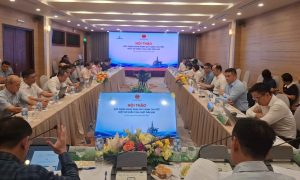
Overview of the workshop
Against this backdrop, the workshop focused on reviewing experience gained during the drafting and development of the amended Petroleum Law, while continuing discussions and soliciting comments on the draft Decree detailing certain provisions of the Law.
The development of the Decree immediately after the Law was passed by the National Assembly highlights the urgent need to promptly complete the implementing regulations. This is also an important step in translating the Law’s principle-based provisions into specific mechanisms, procedures, and responsibilities, thereby minimizing legal gaps once the Law takes effect.
The amended Petroleum Law consists of 12 chapters and 62 articles, adding one chapter while reducing seven articles compared with the 2022 Petroleum Law. The Law is expected to take effect on March 1, 2027.
With its expanded scope and numerous new policies, the quality of the implementing Decree will play an important role in determining how effectively the amended Petroleum Law is put into practice, particularly for large-scale, long-term investment projects that require advanced technologies and involve multiple energy sectors.
From this perspective, the prompt coordination between the Ministry of Industry and Trade (MOIT) and PETROVIETNAM to draft the Decree aims not only to refine the guiding implementation documents, but also serves as a concrete step toward operationalizing new mechanisms—unlocking resources, driving investment, and enhancing the efficiency of petroleum resource exploitation and utilization in the new phase.
Source: PetroTimes – Hội Dầu khí Việt Nam